
Child Nutrition Guide: Healthy Eating & Meal Planning for Early Learners
Written by: Learning Links Early Childhood Educators (Last Updated: August 2026)
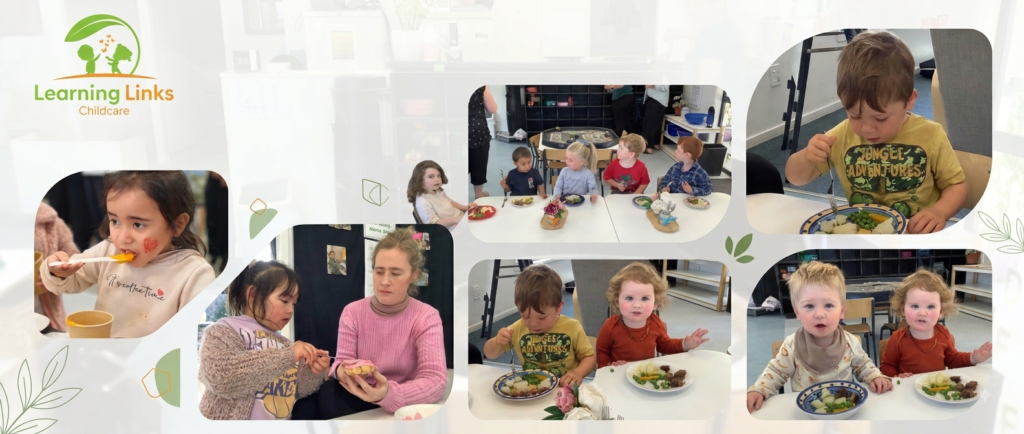
Food is something a good childcare centre thinks about constantly, not just when a policy review’s coming up. Nothing on your child’s plate should be random. There’s a reason behind most of it, even down to why a grape gets cut the way it does. This is a rundown of what should be on the menu and why, what the research actually says, how we cater to dietary requirements and what eating at home should look like.
Recommended Food Groups for Early Childhood Nutrition in NZ
The Ministry of Health‘s guidance for early learning centres highlights four key food groups that every meal should be built around. This includes, fruit and vegetables, grains, milk and dairy and protein (which includes legumes, fish, eggs, poultry or meat). This is the same standard our NZ schools follow as well.
Everyday the goal should be to prepare fresh food, that is low in salt and low added sugar. Treats aren’t off limit either. It is all about balance which is why including treat foods in small quantities can be good for your child. As for drinks it is best to keep it simple with water or plain milk whenever your child wants it.
Why Balanced Nutrition Matters for Early Brain & Body Development
These four food groups aren’t just a checklist, they cover what your child actually needs to grow. Fruit and veg bring the vitamins and fibre that keep energy steady through a long day of play. Grains give lasting fuel rather than a quick spike and crash. Milk and dairy build bones and teeth at a stage where that matters most. Protein is what drives growth and keeps iron levels up, which also plays a part in concentration and mood. Skip one group consistently and it shows up.That’s the whole reason the four groups exist as a standard, not four separate ideas but one balanced plate.
Your child won’t actually finish learning to chew properly until they’re around four. With their smaller airways, and working out how to bite, learning to chew and swallow together takes years, not months which is why it is important to be careful with what they eat.
A 2025 study about New Zealand Early Learning Service Menus. Not all centres properly met the safety guidance. Some foods are cut out entirely because of it such as, nuts, hard lollies, popcorn, whole sausages, and this is not because they’re unhealthy foods. its because there’s no real way to make them safe for your child at a young age. If a centre takes this seriously, they’ll be able to tell you exactly what is and isn’t on their menu with good reason.
For other foods we look to change their form instead of removing them completely. This includes grating, mashing, cutting into smaller pieces, or cooking the food until its soft. There should also always be an adult present, actively sitting with your child while they eat.
Managing Dietary Requirements & Food Allergies in Childcare
Every family is different. A centre’s menu should actually reflect and cater to this. Allergies, intolerances, whatever comes up for your child, need to be communicated clearly so nobody’s guessing. Most centres run a no-nut policy across the board to protect the children who can’t have them at all. Vegetarian, vegan, religious or cultural needs get the same respect and care as allergies.
At home-
These same principles should be applied when it comes to food at home. Make sure to balance each meal with the four food groups where possible. For foods that can be a hazard, prepare them in a way to minimise the risk such as cutting grapes and cherry tomatoes for your child. The risk doesn’t switch off just because you are in the comfort of your own home. Hold off on nuts, popcorn and hard lollies until your child’s closer to four. Sit down together for meals where you can, even ten minutes properly seated beats eating while on the go and try to prioritize water over juice or flavored drinks.
None of this needs to be perfect. It’s not about overthinking every bite. It’s about providing a safe start, and a child who grows up with a positive relationship to food. Got a question, an allergy to flag, or want to see the actual menu? Come find us, we’re happy to talk it through.
FAQ
Q. 1- Why cut grapes and cherry tomatoes into quarters?
Round foods that size are one of the biggest choking hazards for young kids, they’re basically the perfect shape to block a small airway. Quartering them takes almost no time and removes the risk entirely, so it’s an easy one to be consistent about.
Q. 2- My child eats nuts fine at home, why can’t they have them at the centre?
This rule is not about your child specifically. In a group setting, one adult’s watching several kids at once, not one on one like you’d manage at home. Nuts are a high-risk food regardless of how well a child usually manages them, so we keep it consistent across the board rather than making exceptions.
Q. 3- What if my child has an allergy that’s not nut-related?
Tell us and we’ll plan around it properly. The more specific you can be, what to avoid, what happens if there’s exposure, the better we can keep your child safe without them missing out on being included at mealtimes.
Q. 4- Do you cater for vegetarian, vegan, or religious dietary needs?
Yes. Once we know, it gets built into the menu the same as any other requirement, not treated as an afterthought.
Q. 5- My baby’s starting solids soon, what happens at the centre?
We won’t start or change anything without talking it through with you first, timing, first foods, all of it. It’s a conversation, not something we decide on your behalf.
Q. 6- Is it okay if my child doesn’t like what’s on the menu that day?
Completely normal, and not something to worry about. We won’t force a meal, but we’ll gently keep offering it alongside something we know they’ll eat, so the goal is a positive relationship with food, not a clean plate every time.